













Argan oil is easy to use, and easy to use badly. Most complaints, such as greasy hair, a shiny face or the feeling that it did nothing, come from using too much, applying it at the wrong step, or using a product that is not pure argan oil. This guide shows you how many drops to use, when to apply them and in what order, for your hair, face, body and nails.
Quick answer: Start with 1 to 3 drops of pure cosmetic argan oil. Apply it to slightly damp skin or damp hair, and keep it away from the roots if your hair gets oily. Add one drop at a time, and only when you need more.
| Use | Starting amount | When | Where |
|---|---|---|---|
| Hair, after washing | 1 to 3 drops | On damp hair | Mid-lengths and ends |
| Hair, before shampoo | 1 to 2 teaspoons | Once a week or less | Dry lengths and ends |
| Face | 1 to 3 drops | Morning or evening, after water-based products | Whole face, pressed in |
| Body | A few drops per arm or leg | After the shower, skin still damp | Arms, legs, dry areas |
| Elbows, knees, heels | 1 to 2 drops per area | Evening | Dry areas |
| Nails and cuticles | 1 drop per hand | Evening, or after washing your hands | Nail bed and cuticles |
These are starting amounts, not fixed rules. If your skin or hair looks shiny an hour later, use less next time.
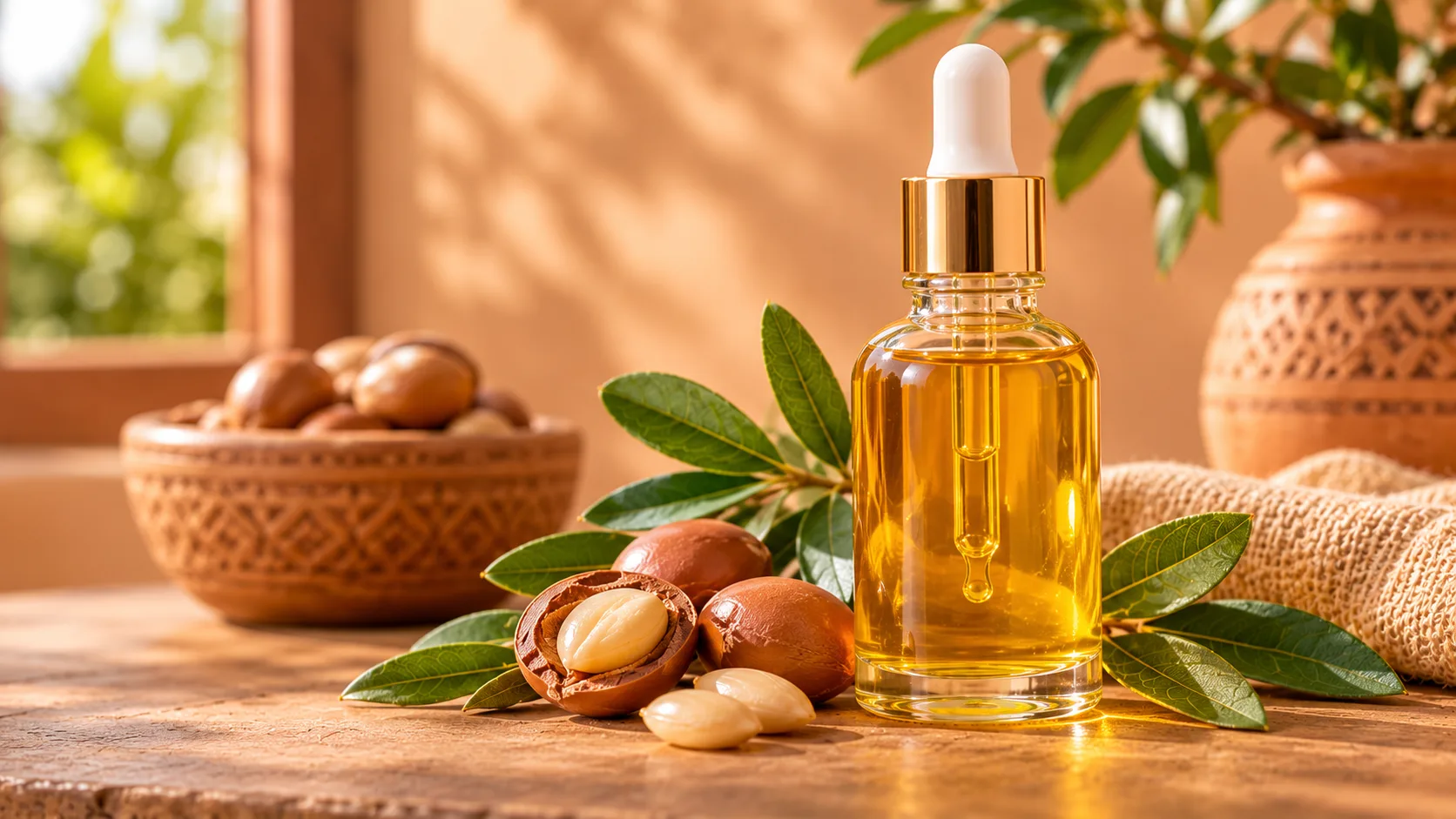
01. What Is Argan Oil?
Argan oil is a plant-based oil extracted from the kernels of the argan tree (Argania spinosa), a tree native to Morocco. It is especially associated with the Souss region, where argan trees have been part of the local landscape and traditional practices for generations.
The oil has a naturally smooth texture and contains fatty acids, including oleic acid and linoleic acid, as well as naturally occurring antioxidant compounds such as tocopherols.
Today, argan oil is widely used in cosmetic products and personal care routines, particularly for moisturizing hair and skin. However, not all argan oil is produced or intended for the same purpose. Understanding the difference between cosmetic and culinary argan oil can help you choose the right type.
Cosmetic vs. Culinary Argan Oil
Argan oil is available in two main types: cosmetic argan oil and culinary argan oil. Although both come from the kernels of the same tree, they are produced for different purposes.
Cosmetic Argan Oil
Cosmetic argan oil is intended for external use on hair, skin, and nails. It is generally made from raw, unroasted argan kernels, giving it a mild, natural scent and making it suitable for personal care routines.
Culinary Argan Oil
Culinary argan oil is produced from roasted argan kernels. Roasting gives the oil a distinctive nutty aroma and flavor, making it suitable for food preparation and traditional Moroccan dishes.
Which Type Should You Choose?
If you want to moisturize your hair or skin, choose cosmetic argan oil that is clearly labeled for external use. If you want to use argan oil in cooking, choose a food-grade product specifically intended for consumption.
Always check the product label and intended use before applying or consuming any argan oil.
Why Choose Pure Moroccan Argan Oil?
Morocco is the natural home of the argan tree, and its argan oil is valued around the world for its versatility in personal care.
Choosing pure Moroccan argan oil means choosing an oil with a simple, recognizable ingredient profile. When shopping for cosmetic use, look for a product that lists Argania Spinosa Kernel Oil as its only ingredient.
Here are a few things to check before buying:
One ingredient: Pure argan oil should not contain added fragrances, mineral oils, or other carrier oils.
Clear labeling: The product should clearly state that it is intended for cosmetic or external use.
Suitable packaging: A tightly sealed, light-protective bottle can help reduce exposure to light and air.
Reliable product information: Check the ingredient list, product details, and storage instructions rather than relying only on marketing claims.
Pure argan oil can be a simple addition to a hair and skincare routine. The key is to choose a clearly labeled product and use a small amount appropriate for your needs.
02. How to Use Argan Oil for Hair
Argan oil can be used in different ways depending on your hair type and the result you're looking for. It is commonly applied to help moisturize dry hair, smooth the appearance of frizz, and add shine.
You can use it on damp hair after washing, apply a small amount to dry hair, or use it as a pre-shampoo treatment.
The best method depends on your hair's thickness, length, and condition. Start with a small amount and adjust gradually to avoid making your hair look greasy.
Below are practical ways to include argan oil in your hair care routine.
Applying Argan Oil to Damp Hair
Applying argan oil to damp hair is a simple way to include it in your post-wash routine. Slightly damp hair can be easier to distribute the oil through, helping coat the strands without using too much.
How to apply it:
Wash your hair and gently towel-dry it until it is damp, not dripping wet.
Place 1–2 drops of pure argan oil in your palms. Use a little more only if your hair is long or thick.
Rub your hands together to spread the oil evenly.
Gently smooth it through the mid-lengths and ends of your hair.
Comb or style your hair as usual.
Tip: Start with just a few drops. Fine or short hair usually needs less, while thicker or longer hair may need slightly more. Avoid applying too much near the roots, especially if your hair gets oily quickly.
Applying Argan Oil to Dry Hair
Argan oil can also be applied to dry hair to smooth frizz and add shine, especially to the ends. This method is useful when your hair needs a quick touch-up between washes.
How to apply it:
Start with completely dry, styled hair.
Put 1 drop of argan oil in the palm of your hand.
Rub your palms together to spread the oil into a thin layer.
Gently smooth your hands over the mid-lengths and ends.
Add another drop only if your hair needs it.
Tip: Use less than you would on damp hair. Applying too much can leave your hair looking oily or weighed down. If you have fine hair, begin with just one drop.
Using Argan Oil Before Shampoo
Using argan oil before shampooing is another way to include it in your hair care routine. Applying it before washing allows you to coat dry hair with a thin layer of oil before cleansing.
How to apply it:
Start with dry hair before your shower.
Apply a small amount of argan oil to your palms.
Distribute it gently through the lengths and ends of your hair.
Leave it on for around 20–30 minutes.
Wash your hair with shampoo as usual. Shampoo again if needed to remove excess oil.
Tip: You do not need to soak your hair in oil. A light application is usually enough. Adjust the amount according to your hair length and thickness.
Overnight Argan Oil Treatment
If your hair is particularly dry, you may choose to leave a small amount of argan oil in your hair overnight as an occasional conditioning treatment.
This method is not necessary for everyone, and using more oil does not automatically provide better results. Start with a light application to see how your hair responds.
How to apply it:
Start with dry or slightly damp hair.
Apply a small amount of argan oil to your palms.
Gently distribute it through the mid-lengths and ends.
Avoid applying excessive oil to your scalp, especially if it tends to become oily.
Protect your pillow with a towel or suitable hair covering.
Wash your hair with shampoo the following morning if needed.
Tip: Try this treatment occasionally rather than assuming it needs to be part of your nightly routine. If your hair feels heavy or greasy afterward, use less oil or choose a shorter treatment instead.
How Much Argan Oil Should You Use?
The right amount of argan oil depends on your hair length, thickness, texture, and condition. Using too much can make your hair look greasy, so it is best to start with a small amount and increase it only when necessary.
Here is a simple starting guide:
Hair TypeSuggested Starting AmountShort or fine hair1 dropMedium-length hair1–2 dropsLong or thick hair2–3 dropsThese amounts are starting points, not strict rules. You may need less or slightly more depending on your hair.
How to find the right amount:
Start with one drop and spread it between your palms.
Apply it mainly to the mid-lengths and ends.
Check how your hair looks and feels after application.
Add another drop only if your hair still feels dry.
Remember: It is easier to add a little more oil than to remove excess oil from your hair. Start small, especially if you have fine or naturally oily hair.
How Often Should You Apply It?
How often you should use argan oil depends on your hair type, condition, and the way you apply it. There is no single schedule that works for everyone.
Here are some practical guidelines:
For daily styling: You can apply 1–2 drops to the ends of your hair when needed to smooth frizz and add shine.
After washing: Use a small amount on damp hair as part of your regular post-wash routine.
As a pre-shampoo treatment: Try it occasionally, such as once a week, if your hair feels dry.
As an overnight treatment: Use it occasionally rather than every night, and adjust based on how your hair responds.
Signs you may be using it too often or applying too much:
Your hair feels greasy or heavy.
Your strands look flat or lack volume.
You notice an oily buildup.
If any of these happen, reduce the amount or frequency of application. The goal is to find a routine that leaves your hair feeling soft without weighing it down.
03. How to Use Argan Oil on Your Face
Argan oil can be used as part of a facial skincare routine to help moisturize the skin and reduce the feeling of dryness. Its lightweight application makes it easy to incorporate into a routine, although the amount you need depends on your skin type.
For best results, start with a small amount and see how your skin responds. You can apply it on its own or after your usual water-based skincare products.
If you have oily or acne-prone skin, introduce argan oil carefully. Even natural oils can cause unwanted reactions in some people, so it is important to test a small area first.
How Much Argan Oil Should You Apply to Your Face?
When applying argan oil to your face, a little usually goes a long way. Start with 1–2 drops and adjust depending on your skin's needs.
How to apply it:
Cleanse your face with your usual gentle cleanser.
Apply your regular water-based skincare products, if you use them.
Place 1–2 drops of argan oil in your palms or fingertips.
Gently spread the oil over your face without rubbing aggressively.
Allow it to absorb before applying any additional products.
Tips for different skin types:
Dry skin: You may find that a small amount helps reduce the feeling of dryness.
Oily skin: Start with just one drop and see how your skin responds.
Sensitive skin: Test the oil on a small area before applying it to your entire face.
Combination skin: Consider applying a little more to dry areas and less to oily areas.
If you notice redness, itching, irritation, or breakouts after using it, stop applying the oil.
When to Apply Argan Oil in Your Skincare Routine
You can apply argan oil in the morning or evening, depending on your skincare routine and personal preference.
Because argan oil is an oil-based product, it is generally best applied after water-based skincare products such as serums and moisturizers.
Morning routine:
Cleanse your face.
Apply your usual water-based serum, if needed.
Apply a small amount of argan oil if your skin needs extra moisture.
Finish with sunscreen with broad-spectrum protection.
Evening routine:
Remove makeup and cleanse your face.
Apply your usual water-based skincare products.
Spread 1–2 drops of argan oil over your face.
Allow it to settle before going to bed.
Tip: You do not need to use argan oil both morning and evening. Start with one application and adjust according to how your skin feels. Always keep sunscreen as the final step of your morning skincare routine.
04. How to Use Argan Oil on Your Body
Argan oil is not limited to hair and facial skincare. It can also be used on the body to moisturize dry skin and improve the feeling of softness.
You can apply it after showering, when your skin is slightly damp, or use a small amount on areas that tend to become dry, such as your elbows, knees, hands, and feet.
Because pure argan oil is concentrated, you do not need to apply a thick layer. Start with a small amount, spread it evenly, and add more only where needed.
Here are two simple ways to include argan oil in your body care routine.
Applying Argan Oil After a Shower
Applying argan oil after a shower is a simple way to moisturize your body. Your skin may still be slightly damp after bathing, making it easier to spread a small amount of oil evenly.
How to apply it:
Take a shower using your usual body cleanser.
Gently pat your skin with a towel, leaving it slightly damp.
Place a few drops of argan oil in your palms.
Rub your hands together to distribute the oil.
Massage it gently into your arms, legs, and other areas that need moisture.
Allow the oil to settle before getting dressed.
Tip: Start with a small amount and apply more only if needed. Using too much oil can leave your skin feeling greasy or make clothing uncomfortable.
Treating Dry Areas
Some areas of the body, such as elbows, knees, heels, and hands, can become particularly dry due to friction, frequent washing, or environmental conditions.
Pure argan oil can be used on these areas as part of your regular moisturizing routine.
How to apply it:
Clean the area and gently pat it dry.
Place 1–2 drops of argan oil on your fingertips.
Massage the oil gently into the dry area.
Allow it a few minutes to settle.
Repeat when needed as part of your daily body care routine.
Extra tip: For very dry areas, you can apply argan oil after a regular moisturizer to help leave the skin feeling soft. Consistent moisturizing is more important than applying a large amount of oil at once.
05. How to Use Argan Oil on Your Nails
Argan oil can also be included in your nail care routine. Its moisturizing properties make it useful for conditioning dry nails and the surrounding cuticles.
Regular application can help keep the skin around your nails feeling soft and moisturized, especially if your hands are frequently exposed to water, soap, or cleaning products.
You do not need a complicated routine. A few drops and a gentle massage are enough to get started.
How to Apply Argan Oil to Your Nails
Applying argan oil to your nails is quick and easy. It can help moisturize dry cuticles and the skin around your nails without requiring special tools.
How to apply it:
Wash your hands and dry them gently.
Place one small drop of argan oil on each hand.
Massage the oil into your nails and cuticles using your fingertips.
Gently massage around each nail, paying attention to dry areas.
Allow the oil to absorb before washing your hands or handling objects.
When to use it:
After washing your hands frequently.
Before bedtime as part of your evening routine.
Whenever your cuticles feel dry.
Tip: Consistent, gentle care can help keep your cuticles soft. Avoid cutting or aggressively pushing back the cuticles, as they help protect the skin around your nails.
06. Common Mistakes to Avoid When Using Argan Oil
Argan oil is easy to incorporate into a personal care routine, but using it incorrectly can make it less enjoyable or leave your hair and skin feeling greasy.
Here are some common mistakes to avoid:
1. Using Too Much Oil
Applying a large amount does not necessarily improve results. Start with a few drops and increase gradually only when needed.
2. Applying Too Much Near the Hair Roots
If your hair tends to become oily, focus on the mid-lengths and ends instead of applying oil directly to the scalp.
3. Ignoring Your Skin Type
Not every product works the same way for everyone. If you have oily, acne-prone, or sensitive skin, start with a small amount and test it on a limited area.
4. Expecting Instant Results
Argan oil is a moisturizer, not a treatment that guarantees hair growth, acne removal, or other medical results. Give yourself time to understand how your hair and skin respond.
5. Choosing Products Without Checking the Ingredients
A product marketed as argan oil may contain other oils, fragrances, or additives. Read the ingredient list if you specifically want pure argan oil.
6. Using Cosmetic Oil for Cooking
Cosmetic argan oil is intended for external use. Never assume that a cosmetic product is safe to consume.
7. Storing the Oil Incorrectly
Keep the bottle tightly closed and away from direct sunlight and excessive heat. Follow the storage instructions on the product label.
07. How to Choose Pure Moroccan Argan Oil
With so many argan oil products available, choosing the right one can be confusing. Some products contain pure argan oil, while others combine it with fragrances, silicones, or additional oils.
If you want argan oil for your hair, face, or body, knowing what to look for can help you make a more informed choice.
Here are the most important things to check before buying.
1. Check the Ingredient List
For pure argan oil, look for a single ingredient:
Argania Spinosa Kernel Oil
If the product contains several ingredients, it may be an argan oil blend rather than pure argan oil.
2. Look for Clear Product Information
A reliable product should clearly explain its intended use, ingredients, and storage instructions. Avoid products with vague descriptions or incomplete ingredient lists.
3. Check the Packaging
Argan oil is best stored in a tightly sealed bottle away from direct sunlight and excessive heat. Dark or opaque packaging can help limit exposure to light.
4. Consider the Intended Use
Make sure the oil is labeled for cosmetic use if you plan to apply it to your hair or skin. Culinary argan oil is a different product intended for food.
5. Avoid Unsupported Marketing Claims
Be cautious of products promising guaranteed hair growth, instant skin transformation, or medical results. Focus on the ingredients and actual product information rather than exaggerated claims.
Final Tip: If your goal is a simple hair and skincare routine, choosing a clearly labeled product with 100% pure argan oil and no added ingredients is a good starting point.
08. Frequently Asked Questions
Here are answers to some common questions about using argan oil for hair, skin, body, and nails.
1. Can I use argan oil on my hair every day?
Yes, you can use a small amount daily if your hair responds well to it. Start with one or two drops on the mid-lengths and ends. If your hair becomes greasy or heavy, reduce the amount or frequency.
2. Should I apply argan oil to wet or dry hair?
You can use it on both. Apply a small amount to damp hair after washing to help smooth the strands, or use one drop on dry hair to add shine and manage frizz.
3. Can I leave argan oil in my hair overnight?
Yes, you can occasionally leave a small amount in your hair overnight as a conditioning treatment. Apply it mainly to the lengths and ends, then wash your hair the next morning if needed.
4. Can I use argan oil on my face every day?
You may use it daily if your skin tolerates it. Start with one or two drops and monitor your skin's response. Stop using it if you experience irritation or unwanted breakouts.
5. Is argan oil suitable for oily skin?
It may work for some people with oily skin, but individual reactions vary. Start with a very small amount and test it on a limited area before applying it to your entire face.
6. When is the best time to apply argan oil to the body?
A convenient time is after showering, when your skin is slightly damp. This makes it easier to spread a small amount evenly over your body.
7. Can argan oil help with dry cuticles?
Yes. You can massage a small drop into your cuticles and the skin around your nails to help moisturize dry areas.
8. How can I tell if argan oil is pure?
Check the ingredient list. Pure argan oil for cosmetic use should list Argania Spinosa Kernel Oil as its only ingredient. Also check the product label and intended use.
9. Does argan oil help hair grow faster?
There is not enough reliable evidence to claim that applying argan oil directly makes hair grow faster. It is mainly used as a conditioning oil to moisturize hair and improve its appearance.
10. Can I use culinary argan oil on my hair or skin?
Culinary argan oil is produced for food use, while cosmetic argan oil is intended for external application. Choose a product specifically labeled for the purpose you need.
09. Final Thoughts
Argan oil is a versatile natural oil that can be used in simple hair, skincare, body care, and nail care routines. Whether you apply it to damp hair, use a few drops on your face, or massage it into dry areas, the key is to start with a small amount and adjust according to your needs.
Choosing pure argan oil with a clear ingredient list can also help you get the most out of your routine. Remember that everyone's hair and skin are different, so pay attention to how your body responds and avoid using more oil than necessary.
With the right product and a simple, consistent routine, pure Moroccan argan oil can become a useful addition to your everyday personal care.