









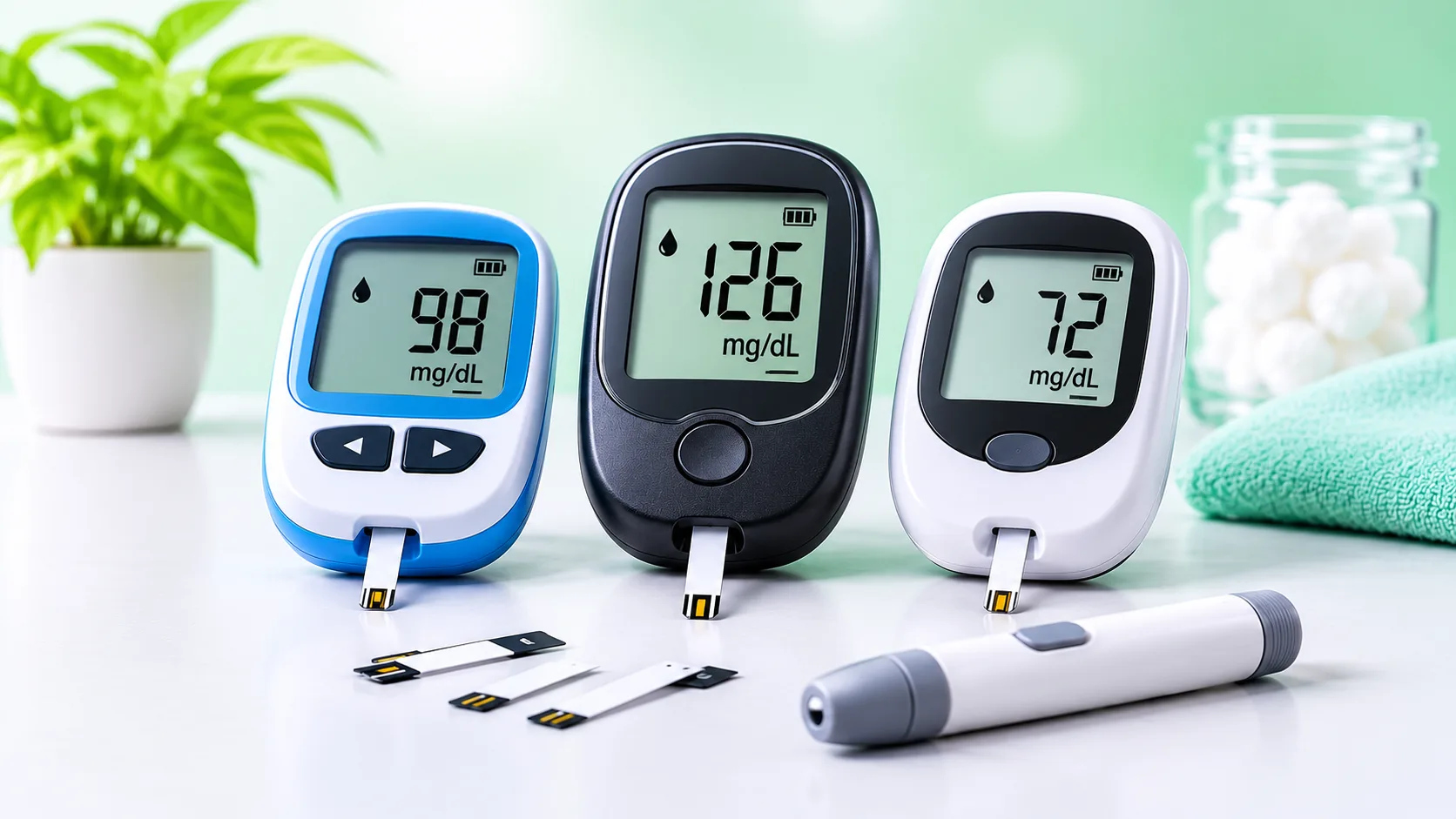
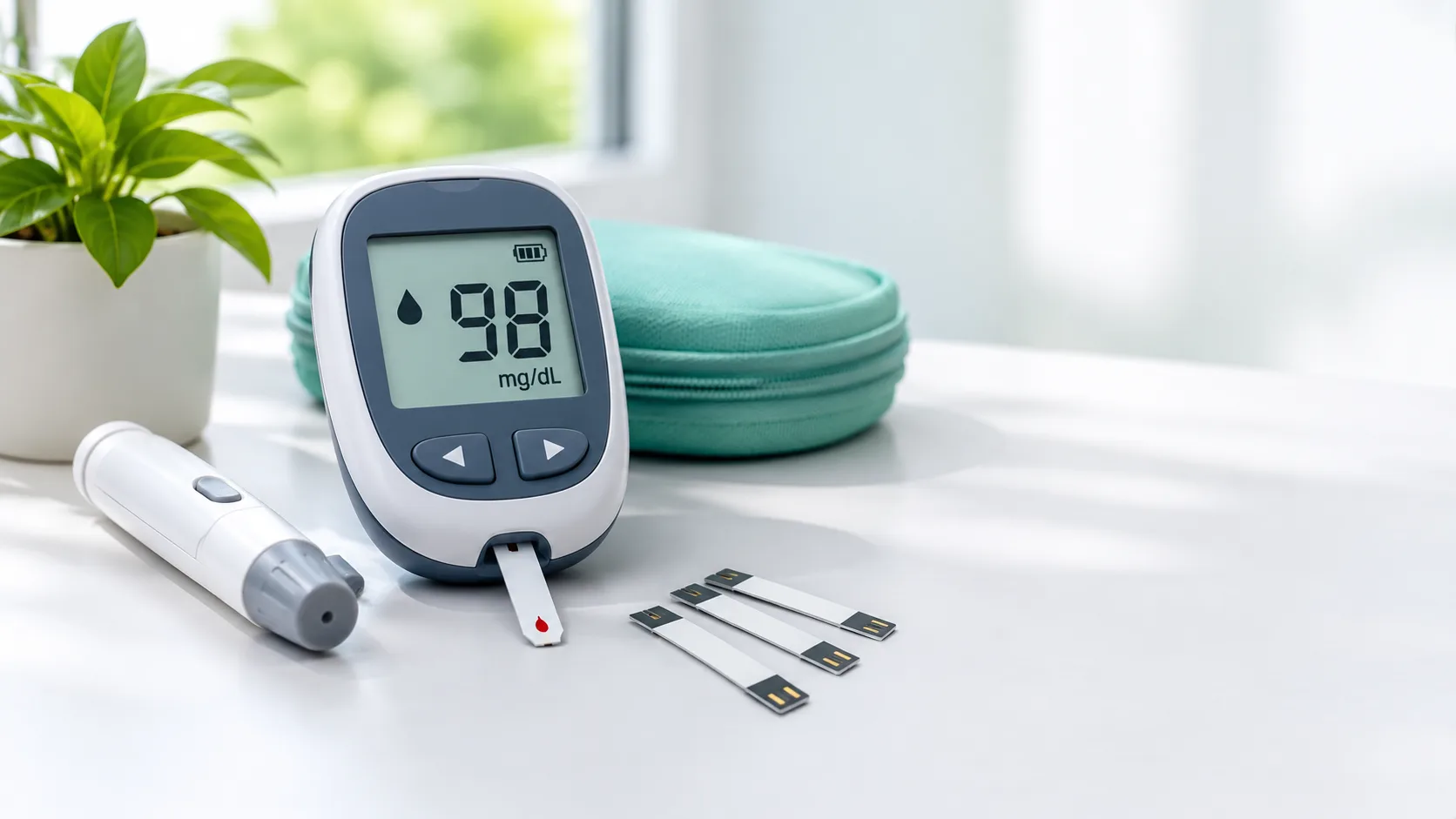
A glucose meter is a small portable device that measures the amount of sugar (glucose) in your blood from a single drop, usually taken from the fingertip. The result appears within seconds.
If you have diabetes, regular checks show you and your doctor how diet, exercise, medication, stress and illness affect your blood sugar, and help you quickly spot dangerously low or high values. With so many models on the market, it can be hard to choose the right one. This guide compares seven popular glucose meters, explains how to choose, and shows you how to test correctly.
01. How to choose the right glucose meter
- Accuracy: look for a meter that meets the ISO 15197:2013 standard, which allows a maximum deviation of ±15% from a laboratory result.
- Cost and availability of strips: the strips, not the meter, are the real long-term expense. Make sure your pharmacy always has them in stock.
- Blood sample size: a smaller sample means a gentler prick.
- Speed: most meters display a result in 5 to 10 seconds.
- Screen readability: a large backlit screen helps older people and those with poor eyesight.
- Memory and averages: useful when you share your results with your doctor.
- Setup: some meters work straight out of the box, others need coding or settings first.
02. The 7 best glucose meters
Here are some of the most popular meters you will find at pharmacies. Features can change from one version to another, so always check the box or leaflet before buying, and ask your pharmacist which models and strips are currently available.
1. Accu-Chek (Performa and Active)
Accu-Chek is a well-known German brand that offers two popular glucose meter models:
1. Accu-Chek Performa
Large, easy-to-read screen.
Simple to use with just two control buttons.
Displays results in about 5 seconds.
Requires a small blood sample (about 0.6 µL).
No setup required; turns on automatically when a strip is inserted.
Up to 4 reminder alarms to help you remember your checks.
Stores up to 500 results.
Shows averages over 7, 14, 30 and 90 days.
2. Accu-Chek Active
Large screen and easy to use.
Post-meal reminder to test 2 hours after eating.
Warning when a strip has expired.
Stores up to 500 results.
Shows averages over 7, 14, 30 and 90 days.
Requires a slightly larger blood sample (about 1 to 2 µL).
Performa or Active: the main differences
Performa: needs no setup and uses a smaller blood sample.
Active: includes a post-meal test reminder and an expired-strip warning.
Both models offer simple blood sugar tracking, but the best choice depends on the features you prefer and your testing needs.
2. FreeStyle Lite
The FreeStyle Lite is a compact meter that is easy to carry and easy to use in low light.
- Small and light, so easy to take when travelling - Result in about 5 seconds - Backlit screen, with a light at the strip slot, useful in a dimly lit room - One of the smallest blood samples on this list (about 0.3 µL), for a gentler prick
3. OneTouch Select Plus
The OneTouch Select Plus is a good choice if you want help understanding your results.
- The colour range indicator shows at a glance whether your result is normal, too high or too low - Meal marking lets you record for each result whether it was taken before or after a meal, to see how food affects your blood sugar - Stores about 500 previous results
4. Contour TS
The Contour TS is a simple, no-frills meter with a large screen.
- Large, easy-to-read screen and a clearly visible strip slot - Result in about 5 seconds from a small sample (about 0.6 µL) - Only two buttons to operate it - No setup needed: you can use it straight out of the box
Availability varies, and some Contour models have been replaced by newer versions. Ask your pharmacist which model and strips are currently sold.
5. Bionime (GM100 and GM300)
Bionime strips are larger and thicker than most, which makes them easier to handle and reduces the risk of touching the blood sample. Results take about 8 seconds, and the meter needs a sample of about 1.4 µL. It comes in two models.
Bionime GM100 - Very light (about 43 g) - Stores about 150 results with date and time - No setup needed - Runs on one battery
Bionime GM300 - Larger screen with easy-to-read numbers - Heavier, about 85 g - Stores about 300 results with date and time - Needs one-time setup before first use, but not with each new box of strips - Runs on two batteries
6. Gluco Dr
The Gluco Dr is an easy-to-use meter with a large screen and a small blood sample (about 0.5 µL). It offers four reminder alarms so you don't forget to test, and it measures a wide range of glucose levels. It comes in two models.
Gluco Dr. Auto - Result in about 5 seconds - No setup needed before use - Stores 250 results
Gluco Dr. Super Sensor - Result in about 10 seconds - Stores 500 results
7. On Call Plus
The On Call Plus is a budget option for people who test regularly and want to keep costs down.
- Result in about 10 seconds - Small blood sample (about 0.5 µL) - Stores 300 results - Relatively low cost compared with the other meters on this list
03. Quick comparison of the 7 glucose meters
- Smallest blood sample: FreeStyle Lite (about 0.3 µL)
- Fastest results (about 5 seconds): Accu-Chek Performa, FreeStyle Lite, Contour TS and Gluco Dr. Auto
- No setup needed: Accu-Chek Performa, Contour TS, Bionime GM100 and Gluco Dr. Auto
- Largest memory (500 results): Accu-Chek Performa and Active, OneTouch Select Plus and Gluco Dr. Super Sensor
- Colour range indicator and meal marking: OneTouch Select Plus
- Budget option: On Call Plus
04. Fingerstick-free meters
Continuous glucose monitoring (CGM) systems, such as the FreeStyle Libre, use a small sensor worn on the back of the upper arm, which reads glucose levels through the skin. Instead of pricking your finger for each test, you scan the sensor with a reader or your phone, or the device sends readings automatically, depending on the model.
CGMs also show trends throughout the day and night, for example your blood sugar rising after a meal or falling during sleep. A single finger-prick test cannot give you that information.
They cost more than a standard meter and are not necessary for everyone. Some models may still require a finger-prick confirmation in certain situations, such as when your symptoms do not match the reading. Ask your doctor whether a CGM suits your condition and treatment.
05. How to use a glucose meter correctly
- Step 1: Wash your hands with warm water and soap, then dry them thoroughly.
- Step 2: Insert a new strip into the meter, which turns it on.
- Step 3: Prick the side of your fingertip with a new lancet. The sides hurt less than the pad.
- Step 4: Touch the edge of the strip to the drop of blood until the meter beeps or starts the countdown.
- Step 5: Wait a few seconds, then read the result on the screen.
- Step 6: Record the result with the time and note whether it was taken before or after a meal.
Tips for more accurate readings
Small mistakes can distort your result, so keep these habits in mind:
- Never test with sugary, wet or cream-covered fingers. - Only use strips designed for your meter and check the expiry date on the box. - Store strips in their closed box, away from heat and humidity. - Don't squeeze your finger hard, as this can dilute the blood sample with tissue fluid. - Use a new lancet every time. - Occasionally compare your meter with a laboratory result, or ask your pharmacist to check it.
06. Normal blood sugar values
Blood sugar targets depend on your situation and the time of the test. Here are common general reference values:
People without diabetes - Fasting (at least 8 hours without eating): about 70 to 99 mg/dL - Two hours after a meal: less than 140 mg/dL
People with diabetes (common general targets) - Before meals: about 80 to 130 mg/dL - Two hours after the start of a meal: less than 180 mg/dL
Low blood sugar (hypoglycaemia) - A reading below 70 mg/dL is considered low and should be treated promptly.
Your doctor may set different targets based on your age, type of diabetes, medication, any pregnancy and other health problems. Always follow your own doctor’s advice.
How to convert mmol/L to mg/dL
Most meters in the United States and many Arab countries display results in mg/dL, but some meters, notably in Europe, Canada and the United Kingdom, display them in mmol/L. To convert mmol/L to mg/dL, multiply by 18:
mmol/L × 18 = mg/dL
For example, 5.5 mmol/L × 18 = 99 mg/dL.
To convert the other way, divide mg/dL by 18.
07. Frequently asked questions
Do readings differ between the left and right hand?
Blood sugar can change from one minute to the next and differ slightly between parts of the body. Small differences between hands or fingers are normal. For consistent results, always test the same side of the fingertip, use the same technique, and note the time of each reading.
Are home glucose meters as accurate as laboratory tests?
Not exactly, but a good meter is accurate enough for daily monitoring. Home meters that meet the ISO 15197:2013 standard can deviate from a laboratory result by up to 15%, so a single reading is not a diagnosis. Laboratory tests, such as HbA1c, are done every few months to assess your long-term control. Use your meter for everyday decisions and laboratory tests for the bigger picture.
Do people with type 2 diabetes also need a glucose meter?
Yes, monitoring helps people with both type 1 and type 2 diabetes. How often you test depends on your treatment, your medication and how well your blood sugar is controlled. Some people test several times a day, others only a few times a week. Ask your doctor to set a testing schedule that suits your situation.
Do test strips have an expiry date?
Yes. Each box of strips has a printed expiry date, and some brands also indicate how long the strips remain usable after the vial is opened. Expired strips can give incorrect results, so do not use them. Store strips in their original closed box, away from heat and humidity, and never keep them in the bathroom or in a hot car.
08. When to contact your doctor
Contact your doctor if you notice any of the following signs:
- Repeated readings outside the target range set by your doctor - Frequent low readings (below 70 mg/dL) - Readings that do not match how you feel - Symptoms of high blood sugar, such as intense thirst, frequent urination, blurred vision or unusual fatigue - Symptoms of low blood sugar, such as shaking, sweating, dizziness, hunger or confusion
Call emergency medical services immediately if you have serious symptoms, such as fainting, seizures, difficulty breathing, persistent vomiting, or a very high or very low reading that does not improve with treatment.
Medical note
« This article is provided for general information only. It does not replace the advice of your doctor or pharmacist. Do not start, stop or change any medication or treatment without speaking to a healthcare professional. »