














How It All Started
Safwane was just an ordinary kid, going to school like everyone else — no different from his classmates, with no special plan for the future. But somewhere along the way, something changed. Through a random chain of YouTube videos, he stumbled upon the world of technology, and it pulled him in immediately.
It started small: Python. He found a YouTube channel called Bro Code and started following along, learning the basics — variables, loops, functions, the building blocks every programmer starts with. There was no course, no mentor, no structured plan. Just curiosity, a laptop, and hours spent watching, typing, and figuring things out on his own.
Within about a week, something shifted. What began as passing curiosity turned into genuine interest. Safwane made a decision that would eventually shape everything that came after: he would learn Django, a powerful backend framework used to build real, working web applications.
That decision was a turning point. Learning Django meant going beyond simple scripts — it meant understanding how websites actually work behind the scenes: databases, logic, structure, and the systems that power real applications. It wasn't easy, and there were many moments of confusion and frustration. But every small victory — every feature that finally worked, every error that finally made sense — built on the one before it.
This was the real starting point of everything Angoer would become. Not a business plan. Not a team of experts. Just a kid, a YouTube channel, and a stubborn decision to keep learning.
Building the E-Commerce Project
The project officially began on August 4, 2025 — the moment Safwane decided to turn what he had learned into something real. What followed was almost a full year of development: a year filled with effort, late nights, and constant research into the right design, structure, and approach. With each iteration, his skills sharpened — a little more each time.
Balancing coding with school wasn't easy. Time was limited, and progress often happened in small gaps between classes and daily responsibilities. But the passion for programming kept bringing him back, even during the busiest weeks.
He published the project on GitHub, and over time kept improving it — refining code, fixing what didn't work, and constantly learning along the way. There were periods when he stepped away from it entirely, only to return with fresh ideas and renewed motivation.
Along the journey, he learned and integrated REST APIs and WebSockets, using WebSockets specifically to power real-time notifications — allowing the platform to update users instantly the moment something happens. This wasn't just theoretical learning; it was applied daily, tested, broken, and rebuilt.
Every late night was another step closer. Attempt after attempt went into trying to launch the project on the web — but there was one major obstacle: money. Hosting, domains, and infrastructure all required a budget that simply wasn't there.
Originally, the idea behind the project was purely commercial — build it, launch it, sell products. But as time passed and the project evolved, Safwane made a different decision: instead of just building another store, he would create something bigger — a brand of his own. And that decision is what produced Angoer, built literally from zero dollars.
The Mistakes, Failures, and Lessons Along the Way
A project like this doesn't come without its fair share of frustration — and building Angoer was no exception. Building a complete e-commerce platform from scratch meant running into problems with no clear answers, no shortcuts, and no one to ask except Google, documentation, and trial and error.
One of the first challenges came with the database structure itself. At first, the models weren't well planned — products, orders, and categories were connected in ways that made simple features unnecessarily complicated. Every time a new feature was added, something else broke. Eventually, this led to a complete redesign of the database schema, restructuring it properly from the ground up so it could actually scale.
Authentication was another major obstacle. Getting user accounts, sessions, and permissions to work securely took several failed attempts — sometimes users stayed logged in when they shouldn't, or lost access when they shouldn't. It took real research into how authentication systems work, not just copying code, to finally get it right.
Real-time features brought their own set of problems. When WebSockets were introduced for live order notifications, the early versions were unstable — notifications sometimes fired twice, sometimes not at all, or connections dropped silently without warning. Debugging that meant learning to read server logs carefully, testing connections manually, and slowly isolating exactly where the fault was.
Performance was another lesson learned the hard way. As more products and test data were added, pages that used to load instantly started slowing down. That prompted a deep dive into database queries, indexing, and understanding why certain operations are expensive — knowledge that only came after watching the platform stumble firsthand.
Then there were the smaller, everyday bugs: broken cart totals, images not displaying correctly, forms failing silently on submit. Each one, on its own, was minor. But together, they built something valuable — patience, and the habit of debugging systematically instead of guessing.
None of these problems were solved immediately. Most were fixed through repeated testing, careful reading of error messages, searching through documentation, and sometimes simply stepping away and coming back with a clearer mind. But every bug fixed left the project — and Safwane — a little stronger than before.
The Migration Error That Almost Broke Everything
One of the hardest bugs came from something that seemed simple at first — changing a field type in one of the models. After modifying the table structure and running makemigrations, Django threw an error, and what should have taken minutes turned into hours of digging through migration files, conflicting dependencies, and database constraints trying to figure out exactly what had broken.
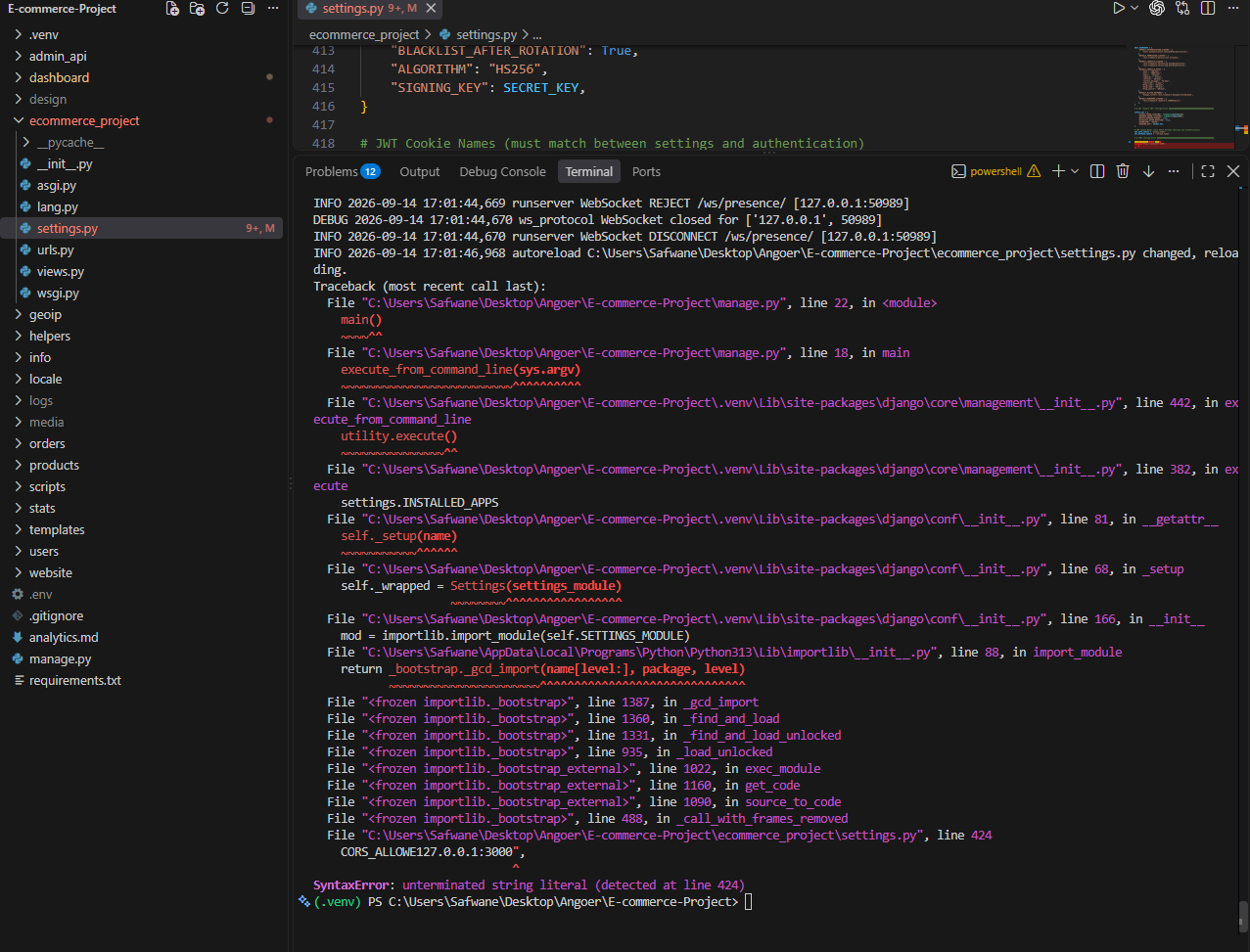
01. How the Migration Error Was Fixed
- Read the full error trace carefully instead of guessing at a quick fix
- Checked the migration files to find where the conflict started
- Removed the broken/conflicting migration file safely
- Adjusted the model field step by step instead of all at once
- Ran makemigrations again to generate a clean migration
- Ran migrate and confirmed the database updated without errors
- Backed up the database before touching migrations again in the future
Why the Name "Angoer"?
Choosing a name is supposed to be one of the fun parts of building a brand — but for Angoer, it turned into one of the hardest and most frustrating parts of the entire process.
The search for the perfect domain name went on for what felt like an eternity. Countless attempts were made — brainstorming with ChatGPT, brainstorming with Claude, testing one idea after another, only to discover that the domain was already taken, unavailable, or just not right. Over 200 attempts went by, each ending with the same result: nothing.
The frustration piled up with every failed search. Then, almost by accident, the breakthrough happened. While typing random letters into a domain checker, the word "django" was typed — a nod to the very framework that started this whole journey. It was, of course, already taken.
But instead of giving up, the letters were tweaked. "Django" slowly transformed, letter by letter, until it became something new: Angoer.
The moment it was typed and the checker showed it was available, everything clicked. There was no deep meaning planned in advance, no branding agency involved — just a spontaneous variation of a word tied to where it all began, discovered in a random moment after hundreds of failed attempts.
Without hesitation, the domain was bought immediately for $8.50 on Hostinger — and that was the exact moment Angoer officially came into existence.
Safwane, Founder of Angoer
"People think building something means you've figured everything out from the start — a clear plan, the right resources, maybe even a team backing you. For me, it wasn't like that at all. It was a kid with a laptop, hundreds of failed attempts, bugs that didn't make sense until suddenly they did, and a domain name that came from pure luck after giving up on finding the 'right' one. Angoer wasn't built because everything went smoothly — it was built because I refused to stop every time something broke. Every crash, every error message, every late night was just another step closer to something real. And looking back now, I wouldn't trade any of those failures, because they're the reason Angoer exists today."